Project
Part of Building a personal brand with AI
How I built this website with AI
3 min read
From brief to a secure, tested site on AWS in less than a working day of my time. I set the direction and made the calls; Claude Code built, tested and reviewed it.
The brief on trying real work in another tool: Are we still finding AI tools by word of mouth?
Personal projectProduct lead, with Claude Code2026
Three actions
Spend the time on the brief first. The time I put into the brief, the research and the design is what made the build fast. The AI never had to guess what I wanted.
Keep the AI’s context up to date. The more the AI knew about the audience, the decisions and the ground rules, the better its work. Update that context as things change, not just at the start.
Make tests and sign-off your safety net. Every feature went from a short design to a plan, then failing tests, then code, and nothing went live without my sign-off. When something broke, the tests caught it before a visitor did.
- of my time, brief to live
- <1 day
- automated tests
- 270+
- environments: dev, staging, live
- 3
The brief
I wanted a site anyone could understand in under a minute, and trust. It had to show how I think about product, data and AI, without anything confidential and without looking like a template.
I also wanted to do something I talk about a lot: use AI for real product work, not demos. So I built it with Claude Code, an AI coding assistant, working alongside me.
How we worked
I was the product lead. I wrote the brief, chose the audience and positioning, and made every trade-off. Claude Code researched peer sites, proposed options, wrote the plans, built the site, wrote the tests and reviewed its own work.
Nothing went live without me. Every change went to a dev site first, every line of copy was mine to approve, and each release to the live site needed my sign-off.
Plans and tests did the heavy lifting. Each feature started as a short design I approved, then a plan, then failing tests, then code. When something broke, the tests caught it before a visitor did.
Key decisions
Static over a CMS. Astro builds plain HTML, so the site is fast, cheap to run and hard to attack.
AWS with three environments. S3 and CloudFront host dev, staging and live, all defined as code in CloudFormation, so any of them can be rebuilt from scratch.
No stored keys. GitHub Actions deploys with short-lived credentials (OIDC), and the live site has its own deploy role that dev can’t touch.
Analytics only with consent. Google Analytics runs only if you accept, and then every click is measured, so I can see what people find useful.
Security
Before adding more features, I asked for a security review of the site and the AWS account behind it. It found no holes in the site itself, and a handful of things worth tightening around it.
We fixed them: a strict content security policy, a live-only deploy role, an activity log (CloudTrail), threat detection (GuardDuty), email records that stop anyone spoofing my domain, and pinned versions for every third-party build step.
Architecture
The diagrams follow the C4 model, drawn as code with the official AWS icons. These two show the big picture; the full set, from system context down to code, lives in the GitHub repo.
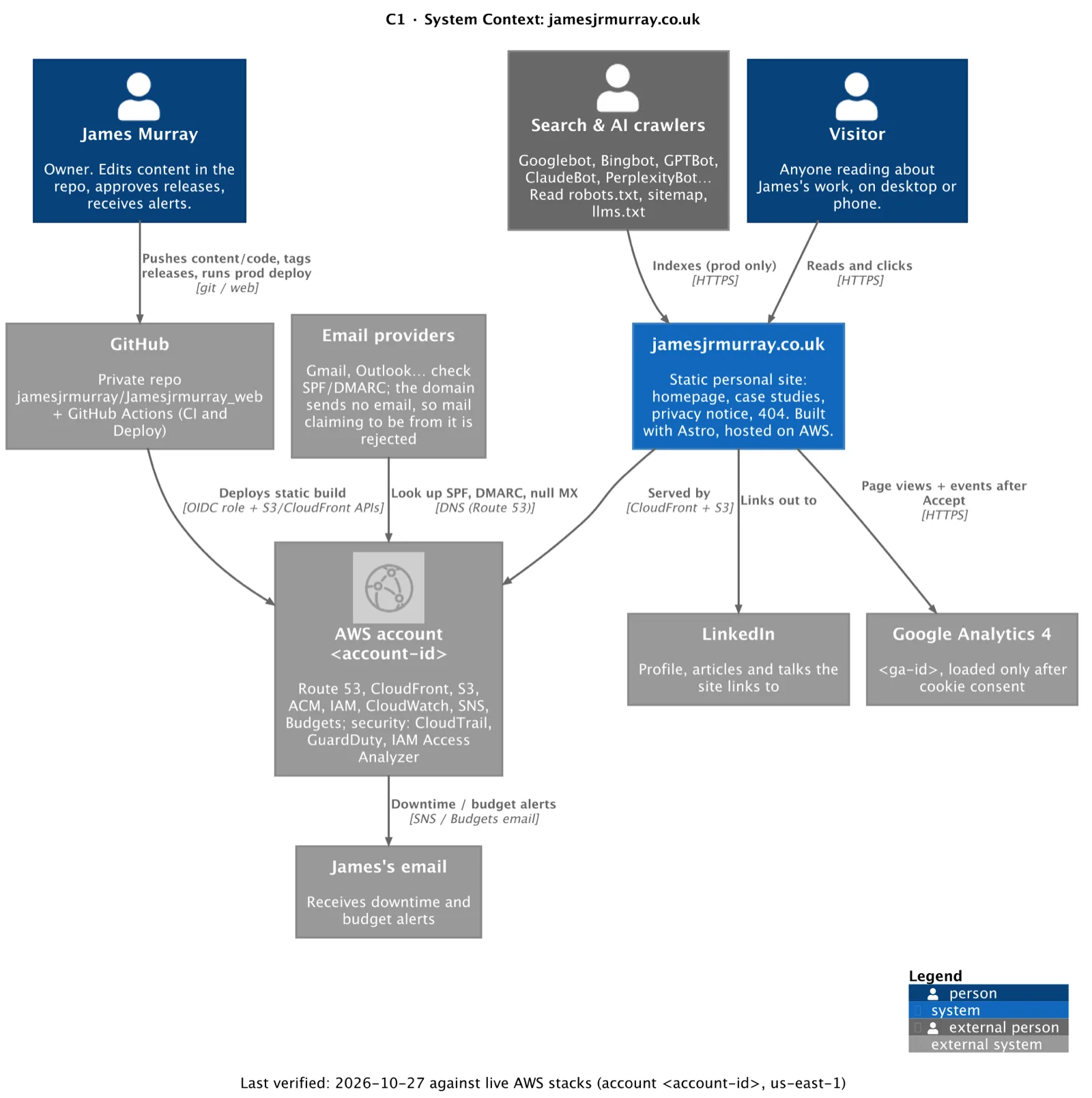
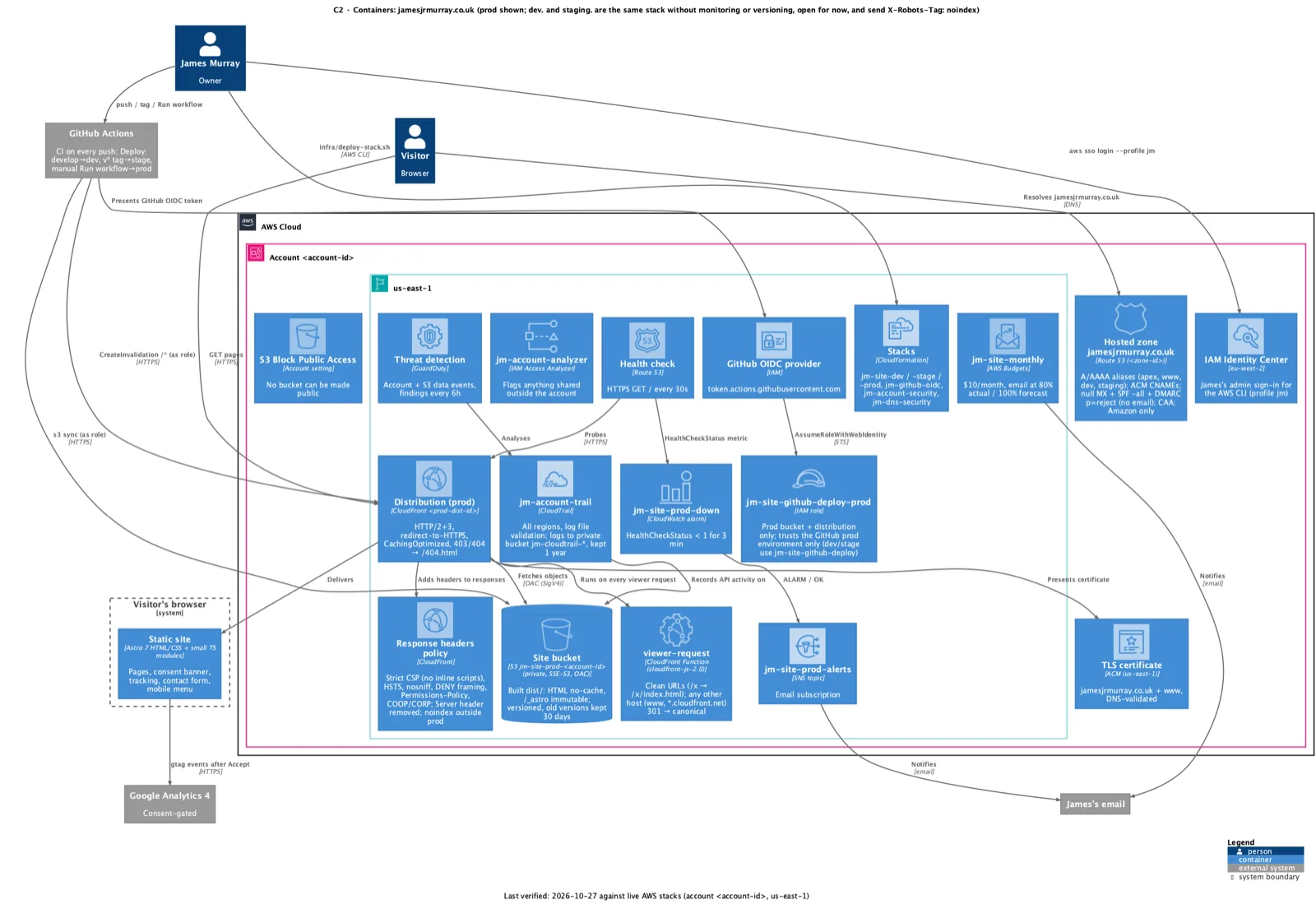
The site’s code is public on GitHub, with private details removed. The diagrams hide account IDs; everything else is as built.
What I learned
Discovery and design pay for themselves. The time I spent on the brief, the research and the design is what made the build fast, because the AI never had to guess what I wanted.
Context is everything. The more the AI knew about the audience, the decisions and the ground rules, the better its work. So I kept that context up to date as things changed, not just at the start.
Research isn’t a one-off. Each new section started by going back to what the best sites in my field do, then updating the plan before anyone wrote code.
The next piece of this story is A multilingual website, and this multilingual site, in five languages.
The longer write-up is the Toyota Connected Europe case study. See speaking on data readiness for AI.
Questions
- What did you want the site to do?
- I wanted a site anyone could understand in under a minute, and trust. It had to show how I think about product, data and AI, without anything confidential and without looking like a template.
- What made the build fast?
- The time I put into the brief, the research and the design is what made the build fast. The AI never had to guess what I wanted.